Posts
Posts


 2:21 PM
 Arvind T.M.
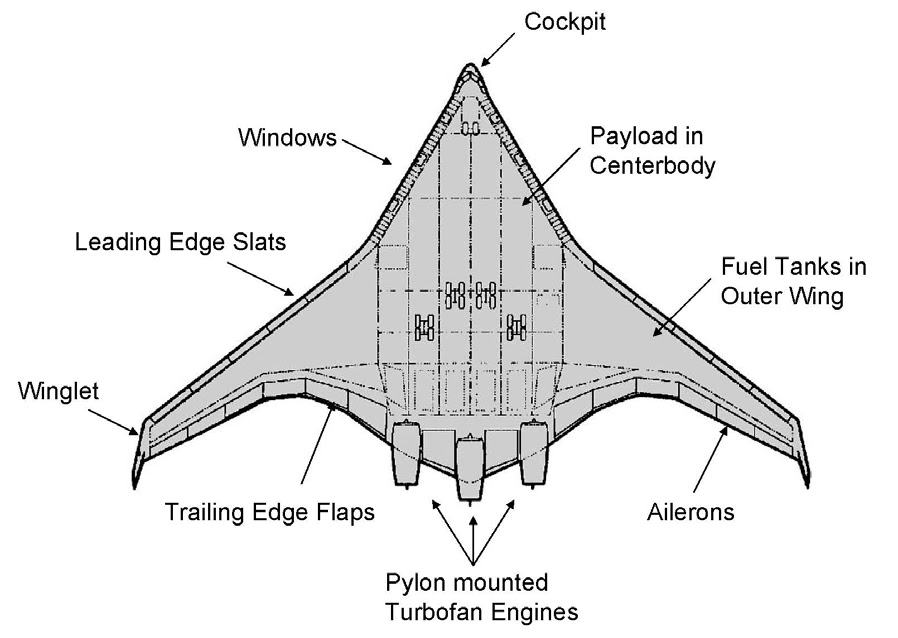
As I mentioned in my previous post, the BWB design had been there for decades, before it came to reality. It was ( and still is) more commonly known as the "Flying Wing". Though some German aviators had toyed with the idea, the actual pioneer behind this was none other than Jack Northrop, the founder of the Northrop Grumman Aircraft company.
Despite the positives, the "flying wing" has many challenges to overcome before it becomes a public reality.The main reason being that it is aerodynamically unstable - due to the presence of only a single wing, there are no fins, rudders, tails etc. These are the vital parts that provide the much needed control to the pilot to maneuver the airplane. Their absence results in two effects:
1) Reduced drag on the aircraft , and thus greater efficiency and speed.
2) Poor stability due to lack of control options.This makes the flying wing inherently risky for any pilot.
3) Large wingspan, which made it physically difficult to accomodate in airports.
Apart from this, there are very few windows in the seating area, and it is difficult to pressurize the entire cabin due to its eccentric shape.
The trouble with the flying wings in the past :-
One of the most important components of a flying wing aircraft are on-board computers. One of the earliest Flying wings was the Northrop YB-49... with a 53 foot wingspan and 8 General Electric turbojet engines, this was really , really large aircraft for its time ( the 1940s).
As mentioned before, it was highly unstable. Pilots had a hard time keeping it on leash, and by the end of the decade, the US Airforce had all the jets scrapped.
The reason - Lack of a common control mechanism which could help the pilot in maintaining optimum parameters for each of the engines, wings etc. , which could not be otherwise possible manually.
Herein arose the need for a computer, which could carry out these operations with minimal human interference, and thus maintain the much elusive aerodynamic stability required by the flying wing. And as you all know, the 1950s was not the computer age.
Hmm...What was done to overcome it :-
So just when you thought that flying this thing would be a straight ticket to heaven, some really ultra brilliant aero geeks ( read : Aerospace engineers at Northrop Grumman ) found ways out to bypass it with
The Fly-by-Wire system ( More about that in my future posts ) But more significantly, it used on-board aircraft computers to control various flight parameters, for a safe,healthy flight :-).
This colossal effort,made the flying wing became a worldwide phenomenon once it was introduced in one of the most admired aircraft of all times - The B-2 Spirit Stealth Bomber, in 1989.
With 130 on-board computers ( !!! ), the B-2 was an airborne computing powerhouse controlling every aspect of its flight- weather,engines,targeting,autopilots etc. etc. Pilots spent a whopping 40 hours in continuous flight, aided by mid air refueling and laptop computers, into which they could ( quite literally) key in their whims and fancies, which the computer faithfully obeyed.
This machine became an overnight sensation, being one of a kind - with an equally potent destructive power.
But more importantly,after almost 4 decades of struggle, the Flying wing had finally come of age.
Despite the positives, the "flying wing" has many challenges to overcome before it becomes a public reality.The main reason being that it is aerodynamically unstable - due to the presence of only a single wing, there are no fins, rudders, tails etc. These are the vital parts that provide the much needed control to the pilot to maneuver the airplane. Their absence results in two effects:
1) Reduced drag on the aircraft , and thus greater efficiency and speed.
2) Poor stability due to lack of control options.This makes the flying wing inherently risky for any pilot.
3) Large wingspan, which made it physically difficult to accomodate in airports.
Apart from this, there are very few windows in the seating area, and it is difficult to pressurize the entire cabin due to its eccentric shape.
The trouble with the flying wings in the past :-
One of the most important components of a flying wing aircraft are on-board computers. One of the earliest Flying wings was the Northrop YB-49... with a 53 foot wingspan and 8 General Electric turbojet engines, this was really , really large aircraft for its time ( the 1940s).
As mentioned before, it was highly unstable. Pilots had a hard time keeping it on leash, and by the end of the decade, the US Airforce had all the jets scrapped.
The reason - Lack of a common control mechanism which could help the pilot in maintaining optimum parameters for each of the engines, wings etc. , which could not be otherwise possible manually.
Herein arose the need for a computer, which could carry out these operations with minimal human interference, and thus maintain the much elusive aerodynamic stability required by the flying wing. And as you all know, the 1950s was not the computer age.
Hmm...What was done to overcome it :-
So just when you thought that flying this thing would be a straight ticket to heaven, some really ultra brilliant aero geeks ( read : Aerospace engineers at Northrop Grumman ) found ways out to bypass it with
The Fly-by-Wire system ( More about that in my future posts ) But more significantly, it used on-board aircraft computers to control various flight parameters, for a safe,healthy flight :-).
This colossal effort,made the flying wing became a worldwide phenomenon once it was introduced in one of the most admired aircraft of all times - The B-2 Spirit Stealth Bomber, in 1989.
 |
| Trendsetter- The B-2 Stealth Bomber |
With 130 on-board computers ( !!! ), the B-2 was an airborne computing powerhouse controlling every aspect of its flight- weather,engines,targeting,autopilots etc. etc. Pilots spent a whopping 40 hours in continuous flight, aided by mid air refueling and laptop computers, into which they could ( quite literally) key in their whims and fancies, which the computer faithfully obeyed.
This machine became an overnight sensation, being one of a kind - with an equally potent destructive power.
But more importantly,after almost 4 decades of struggle, the Flying wing had finally come of age.